DOW-UAP-D102
UnresolvedThe Tremonton film (Utah, 1952)
On July 2, 1952, a Navy photographer films a group of bright dots over Utah from the roadside. The Navy cannot identify them; the Air Force ends up saying they were seagulls. The file fully supports neither claim.
- Date
- Jul 2, 1952
- Location
- About 7 miles north of Tremonton, Utah, on Highway US-30SFilming point according to Douglas Aircraft (41°50′ N, 112°10′ W). The distance to the objects was never measured.See the area on the globe →
- Platform
- From the ground, hand-held camera · Delbert C. Newhouse, Navy chief photographer [1 · p. 14, 23, 113][5 · p. 295]
- Sensor
- 16 mm Kodachrome film at 16 fps · Bell & Howell Auto Master with a 3″ telephoto lens (according to the witness) [1 · p. 113]
- Official status
- Unresolved · Project Blue Book evaluated it as “Unknown” and PURSUE publishes it among unresolved cases. In 1956 the Air Force publicly attributed it to seagulls [1 · p. 58, 126–127][7]
01 Sensor readout
Official video · verified linkWatch the DOW-UAP-D102 video DVIDS · PURSUE · 70.1 s · 1920×1080 · 44.5 MBReleased Sep 18, 2026 · checked Oct 6, 2026 · SHA-256 59f447056ece…Opens on the official site. The frames below are taken from this very file; the built-in player arrives in V2.
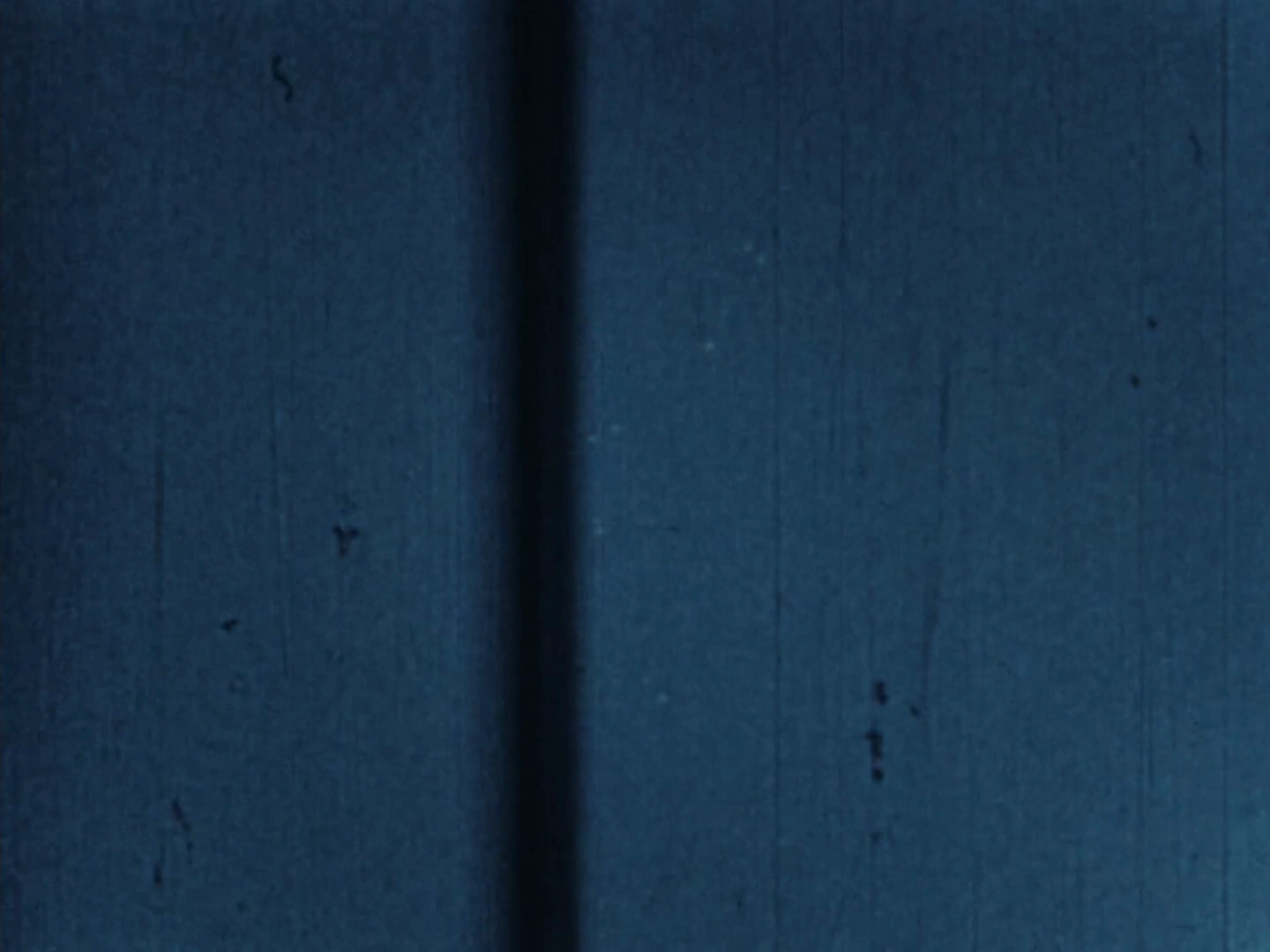
Frame from the published copy, in its first and brightest stretch. The objects are among the faint white dots; they are not marked because on a copy of a copy they cannot be told apart from dirt with certainty. With no reference in the sky, the distance cannot be measured.
Frame · Video 11.0 s · U.S. Air Force · Project Blue Book (National Archives 341.PBB.345) / DVIDS · PURSUE · Public domain
Image record
- Author
- U.S. Air Force · Project Blue Book (National Archives 341.PBB.345)
- Origin
- DVIDS · PURSUE
- Original file
- 1023402 ↗
- License
- U.S. Government work: no U.S. copyright (17 U.S.C. § 105)
- Retrieved
- 2026-10-06
- Video SHA-256
- 59f447056ecebee35d69bc58bb6a4468f5b6d4692b55e96e61985f89ff4a725e
The appearance of U.S. Department of War (DoW) visual information does not imply or constitute DoW endorsement.
02 Images from the file
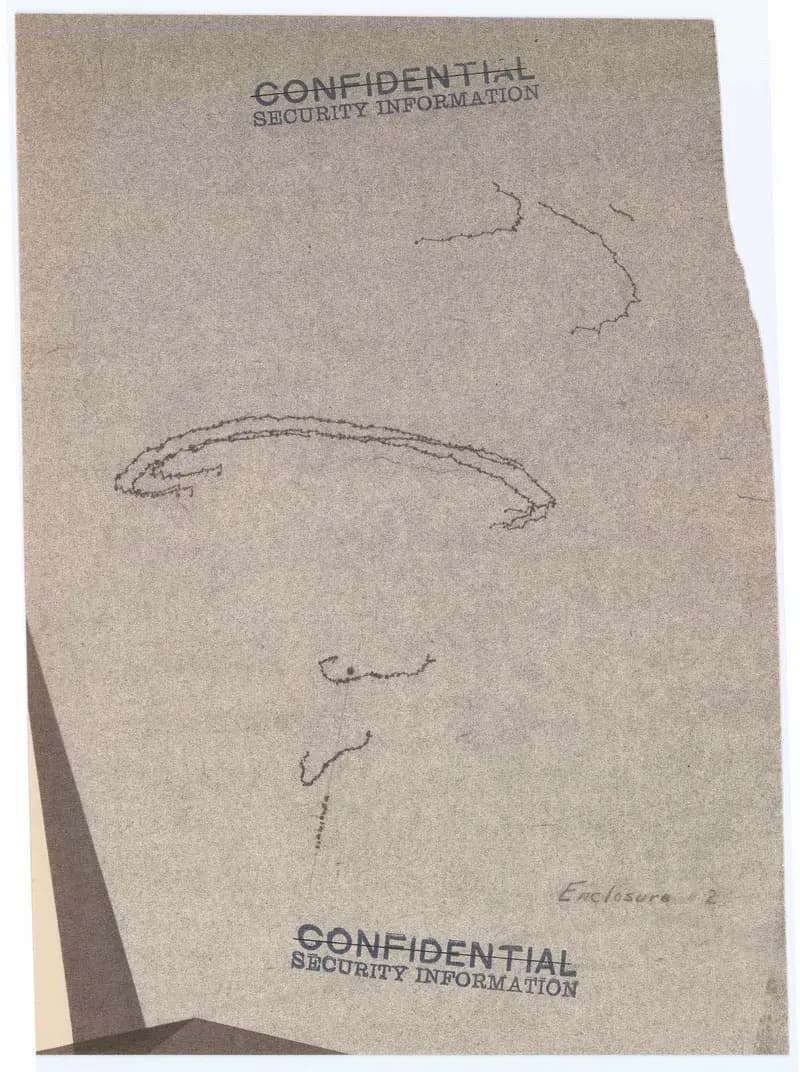
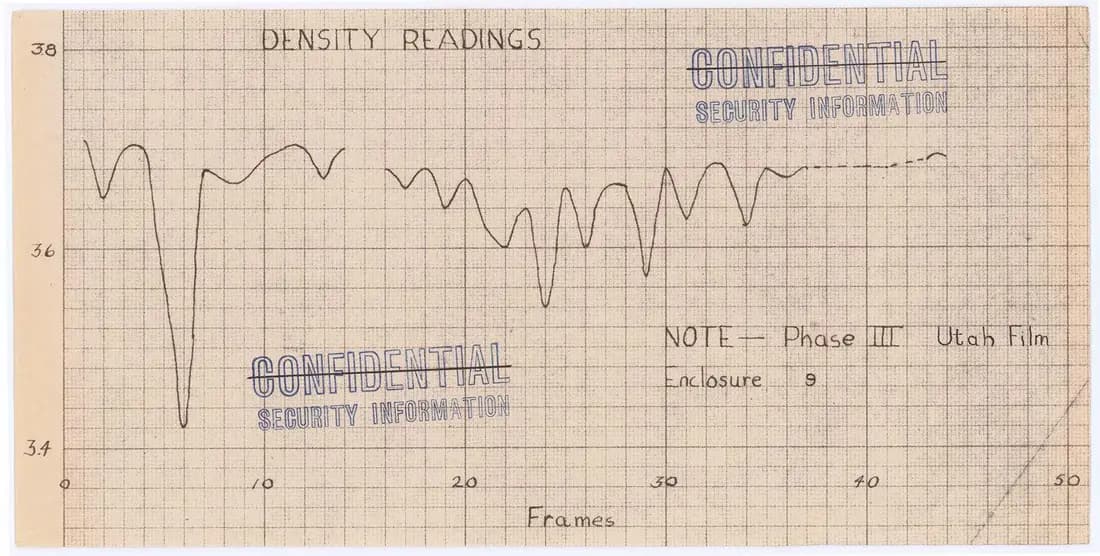
Only images from the records themselves: official pages, charts and photos, and drawings the witnesses handed in. Artist's recreations and AI-generated images are not shown, even when the catalogue includes them.
03 Timeline
At 11:10, near Tremonton, Newhouse stops the car and films about 30 feet of film: 10 to 12 objects “milling about” westward; one reverses course and he follows it with the camera held still. [1 · p. 113]
The Air Force interviews the family: 12 to 14 objects, no sound or trails. It rates the witness an “expert photographer”; he believes the light was reflected. [1 · p. 14][6 · p. 31–32]
First Navy report: they look like light sources, no bird reflects that much and they cannot be aircraft or balloons. [1 · p. 129–133]
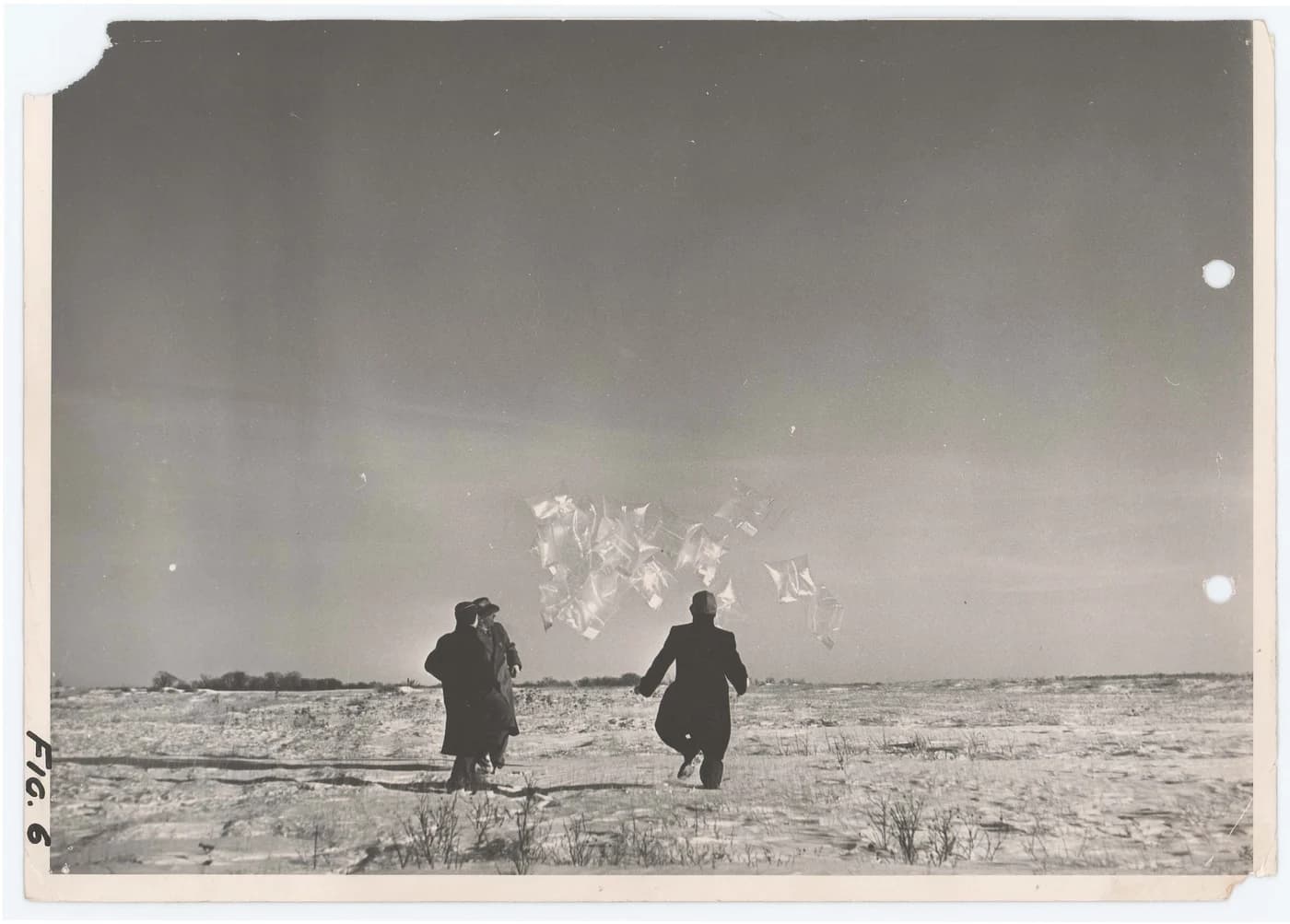
Balloon experts from General Mills, the Navy and the University of Minnesota watch the film: it closely resembles “pillow” balloons. The most sceptical finds them “a bit too bright”. Tracing the balloon shipments comes up empty. [1 · p. 28–29, 80]
A Project Blue Book memo proposes releasing the film without comment, hoping no one asks about the Navy report, and saying they are “balloons or gulls”. [1 · p. 37–39]
Final Navy report: it cannot identify them as natural phenomena or known man-made objects. It computes up to 2,457 mph assuming, “arbitrarily”, that they were 5 miles away. [2 · p. 4–7]
The original is lost: the Air Force does not have it and the Navy says it never did. Every analysis was made on copies. [1 · p. 45, 49]
The Pentagon answers the press: seagulls, with “identifiable seagulls in some of the frames” and the “unanimity of opinion” of every evaluation. [1 · p. 126–127]
Douglas Aircraft analyzes a copy: no natural hypothesis fully explains it and it reaches no conclusion. [1 · p. 82–88]
PURSUE releases the file and a National Archives copy of the film. [7][3]
04 Hypotheses
Status as stated by the official sources cited. The archive takes no side.
- Compatible
Seagulls soaring in the sun
The Air Force's public position since 1956. Douglas finds it possible only within a mile. The Navy and the file's laboratory analysis rule it out on brightness. [1 · p. 87, 126–127, 136][2 · p. 4]
- Ruled out
General Mills “pillow” balloons
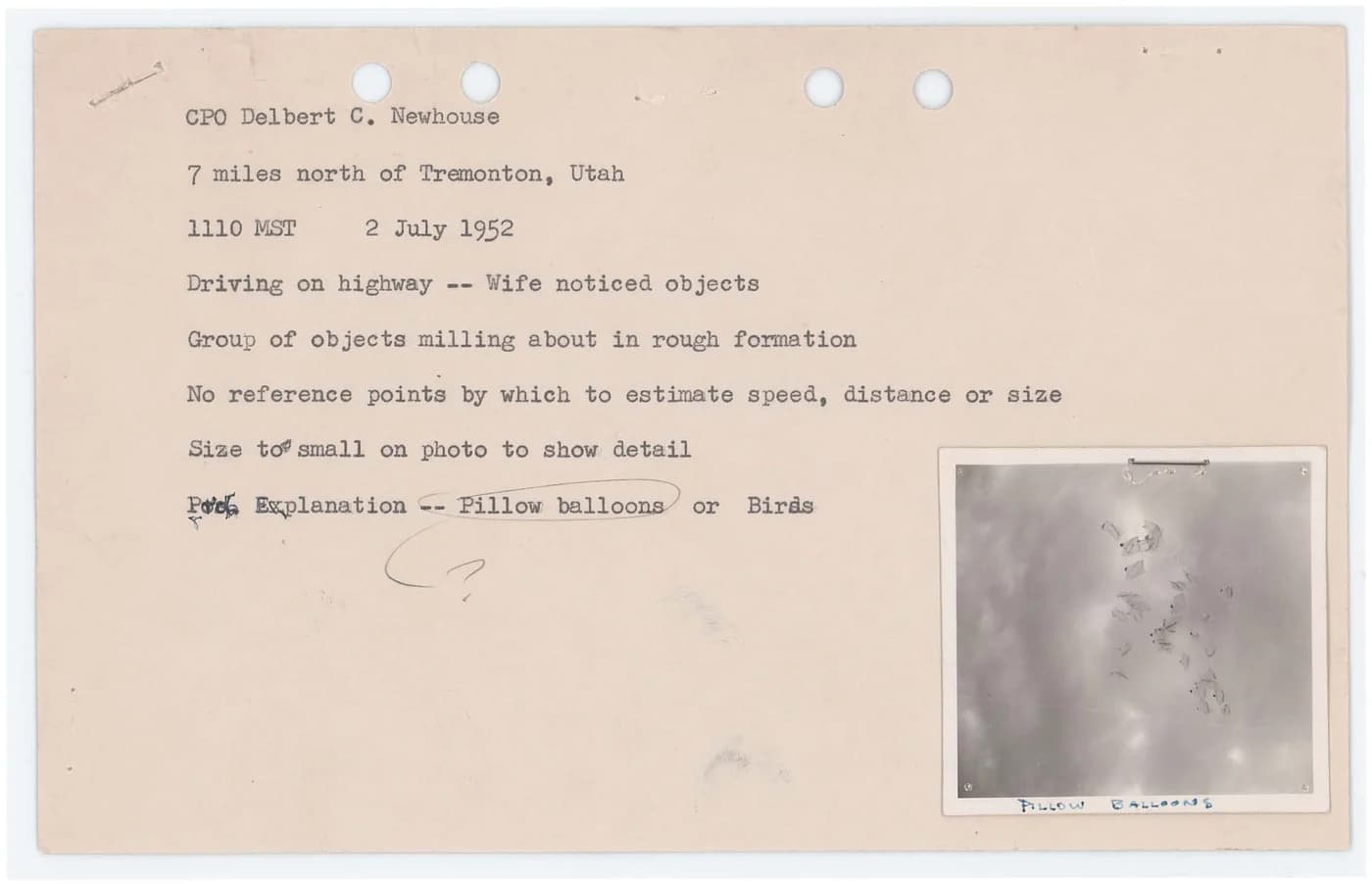
Balloon experts found them very similar, but tracing the shipments came up empty. The Blue Book sheet notes “too many objects for balloons” and Douglas finds them improbable. [1 · p. 28–29, 58, 80, 86]
- Ruled out
Aircraft
No one heard engines and the Blue Book sheet calls them “highly improbable”. Only the laboratory analysis leaves aluminum aircraft open. [1 · p. 14, 37, 58, 136]
- Compatible
Unknown high-speed objects
The Navy's reading in 1953. Its speeds depend on a 5-mile distance no one measured: the report itself calls it arbitrary. [2 · p. 4–7]
05 Testimony
“a group of about ten or twelve objects - that bore no relation to anything I had seen before”06 Editor's reading
The editor's opinion, not an official finding. It rests on the records cited and changes if they do.
- Conventional explanation likely
- Open
- Anomalous
- The witness is solid and the film authentic: a photographer with more than 1,000 flight hours, rated “extremely honest and reliable”, and footage the laboratory finds “extremely difficult to imitate”. [1 · p. 14, 139]
- The extraordinary speeds prove nothing: they come from an assumed distance. If the objects were within a mile, the motion fits birds. [2 · p. 5][1 · p. 87]
- The seagulls were asserted, not shown: in 1956 there is talk of identifiable gulls and unanimity, but no document in the file points to those frames, the laboratory says the images show no detail and the evaluation sheet says “Unknown”. [1 · p. 58, 126–127, 136]
- What keeps it open: with no reference point in the sky the distance cannot be measured, and without distance neither the Navy's speeds nor the seagulls can be shown. The original was lost. [1 · p. 45, 49, 84]
— Isaac Chaves, editor · Reading of
07 Discrepancies between sources
- In 1956 the Pentagon speaks of a “unanimity of opinion” that they were seagulls. The file does not bear it out: the Navy rules them out, the laboratory says they outshine any white bird, the Blue Book sheet marks “Unknown” and Douglas reaches no conclusion. [1 · p. 58, 88, 126–127, 136][2 · p. 4]
- The film format: the witness handed in a 16 mm roll, but in October 1952 Project Blue Book writes that “the 35mm roll is the original film”. The Navy center corrects it in 1954. [1 · p. 9, 45, 113]
- The camera: the witness declares a Bell & Howell Auto Master with a 3″ telephoto lens; the Navy center speaks of a 16 mm Revere with an F1.9 lens. [1 · p. 45, 113]
- The number of objects: 10 to 12 in the witness's letter, 12 to 14 in the interview and 10 in the laboratory analysis. The Navy accepted only 11 images as valid. [1 · p. 14, 113, 132, 136]
- The original: in December 1953 the Air Force notes it is in ATIC's files; in January 1954 ATIC says it does not have it and that it may have deteriorated; in March, the Navy center says it never had it. [1 · p. 45, 49, 50]
- The published film is not the full roll: it is a National Archives copy without the Idaho mountain scene the witness shot at the end, and with a few seconds of a sewing machine unrelated to the case. [3][1 · p. 113]
08 The case in PURSUE
How PURSUE publishes this case: its official description and every record, with links to the files. Reproduced as is, catalogue errors included.
Official description
This document records the Project Blue Book investigation and subsequent assessments of an incident near Tremonton, Utah, on July 2, 1952. Project Blue Book was a 1952-1969 U.S. Air Force program to investigate the nature and origin of unidentified flying objects (UFOs). The file describes the Air Force’s assessment of the principal witness, Delbert C. Newhouse, a U.S. Navy Warrant Officer specializing in photography, as honest and reliable, and as an expert with more than 1,000 hours of aerial-photography experience. Newhouse reported observing 12 to 14 reflective objects and recorded the event on color motion-picture film using a handheld Bell & Howell Auto Master camera.
The file reflects an evolving Air Force assessment of the imagery over several years. Early documentation considered several possible explanations, including sunlight reflecting from birds or balloons, and a mirage effect, and did not identify the objects conclusively. Later assessments became more confident that the objects were seabirds reflecting sunlight, citing identifiable seabirds and similar films showing seabirds as bright points of light under comparable conditions. However, the film’s limited detail and lack of fixed reference points prevented reliable determination of the objects’ distance, size, altitude, or linear speed from the film alone.
AARO comment
The file contains conflicting references to the film format. Several documents describe a 35mm film, while contemporaneous submission documentation identifies the original as a 50-foot roll of processed 16mm Kodachrome color motion-picture film recorded with a handheld Bell & Howell Auto Master camera. Newhouse reported exposing approximately 30 feet of the roll during the incident and using the remaining film later that day to record unrelated mountain scenery in Idaho. Other records show that 35mm positive and negative duplicate blowups were produced from the original 16mm material. The file also indicates that the original film was duplicated for preservation, citing its deteriorating condition. The footage retained by the National Archives and Records Administration and presented in this collection as DOW-UAP-PR159 is a digitization of a 16mm print.
Catalogue records · 6
DOW-UAP-D102 · Document · Department of War · Sep 18, 2026 · Main record
Project Blue Book File on Tremonton Film, Utah, 1952
7/2/52 · Tremonton, Utah
DOW-UAP-D098 · Document · Department of War · Aug 7, 2026
Film Analysis of Unidentified Objects, 1953
1950, 1952 · Montana, Utah
Official description
This file contains a memorandum relating to the U.S. Naval Photographic Interpretation Center’s assessment of two films allegedly depicting unidentified airborne objects, captured in Montana and Utah in 1950 and 1952, respectively. The file documents the Center’s analytic process, assumptions that constrained its confidence level, tentative conclusions, and recommendations for future research. The Center assessed, generally, that the objects depicted in the film demonstrated characteristics that were inconsistent with those of natural phenomena or commonly known aerospace technologies. The memorandum documents the Center’s recommendation for a more well-resourced investigation to corroborate its presumptive findings, citing a lack of funding and personnel. The accompanying charts compare the film’s luminosity with the apparent angular size of the phenomena, using contemporary mathematical modeling and photogrammetric analysis techniques.
DOW-UAP-D103 · Document · Department of War · Sep 18, 2026
Project Blue Book Photo File Relating to Tremonton Film, Utah, 1952
7/2/52 · Tremonton, Utah
Official description
During its investigation of a July 1952 film of an incident reported near Tremonton, Utah, Project Blue Book examined whether the objects recorded on film might have been “pillow balloons.” Project Blue Book was a U.S. Air Force program active from 1952 to 1969 that investigated the nature and origin of unidentified flying objects (UFOs). In December 1952, investigators contacted General Mills, Inc., the only known manufacturer of pillow balloons at the time, to determine whether a balloon release could account for the incident.
The file includes example imagery of pillow balloons supplied by General Mills Research Laboratories. In late December 1952, Project Blue Book personnel, balloon specialists, and representatives from General Mills reviewed the Tremonton footage. The group’s consensus was that the objects closely resembled pillow balloons in flight and behaved consistently with that explanation. One General Mills representative was less convinced, noting that the objects appeared somewhat too bright and seemed to maneuver too rapidly.
The reviewers also questioned previous angular-velocity calculations suggesting that the objects moved at a high rate of speed because those calculations depended on the unverified assumption that the camera operator had held the camera still during filming. Subsequent efforts to identify a pillow-balloon release in the Tremonton area were unsuccessful. The file also considered seabirds as a possible explanation, citing similar films showing seabirds as bright points of light under comparable conditions. Later Air Force assessments favored the seabird attribution.
DOW-UAP-D104 · Document · Department of War · Sep 18, 2026
Final Personnel Record for Newhouse, Delbert C., U.S. Navy, 1957
5/2/57
Official description
This file contains the final personnel record of U.S. Navy Chief Warrant Officer Delbert C. Newhouse, who left naval service as a Chief Warrant Officer 4, then the highest Warrant Officer grade. In July 1952, Newhouse recorded 16mm motion-picture film near Tremonton, Utah; the film later became the subject of a Project Blue Book investigation. Project Blue Book was the U.S. Air Force program active from 1952 to 1969 that investigated the nature and origin of unidentified flying objects (UFOs). In addition to documenting routine assignments and training, the file records Newhouse’s career progression as a Photographer’s Mate, a Navy enlisted specialty responsible for photography and related imaging work. Project Blue Book investigators characterized Newhouse as an expert photographer based on his naval experience.
DOW-UAP-D105 · Document · Department of War · Sep 18, 2026
U.S. Air Force Flying Discs File, 1952
September - December 1952 · Various
Official description
This file is an archival collection of U.S. Air Force Director of Intelligence records relating to reported “flying disc” incidents during the period from September through December 1952. Drawn from multiple governmental and non-governmental sources, it compiles a wide range of material associated with reported sightings and official handling of those observations, rather than presenting a single analytical conclusion on the nature or origin of “flying discs.” The contents include correspondence, memoranda, reporting forms, case summaries, distribution and routing material, and other administrative or intelligence-related documentation tied to flying-disc reporting and review during that period. Pages 26-36 of the file refer to an incident reported near Tremonton, Utah, in July 1952, in which a U.S. Navy Warrant Officer recorded film of unidentified objects that the Air Force later assessed were likely seabirds. Overall, the file is a broad documentary collection reflecting how such reports were recorded, circulated, and evaluated in late 1952.
DOW-UAP-PR159 · Video · Department of War · Sep 18, 2026
Historical Film of Reported UFOs, Utah, 1952
7/2/52 · Tremonton, Utah
Official description
This archival footage is a digitization of a 16mm print of Kodachrome color motion-picture film shot on a handheld Bell & Howell Auto Master camera near Tremonton, Utah, on July 2, 1952. U.S. Navy Chief Warrant Officer Delbert C. Newhouse reported observing and filming a group of bright airborne objects and shortly thereafter submitted the footage to the U.S. Air Force. The film later became one of the visual cases reviewed by Project Blue Book, the 1952–1969 U.S. Air Force program that investigated the nature and origin of unidentified flying objects (UFOs). The film’s limited detail and lack of fixed reference points prevented a conclusive resolution. From the 55-second mark onward, the film transitions to unrelated footage appearing to show a demonstration of sewing equipment. The presence of unrelated sewing-equipment footage suggests that the surviving footage may be a composite or reused print, though the available record does not establish how or when the materials came to be combined. As documented in records submitted with the film, contained in this collection under the title DOW-UAP-D102, the footage originally was paired with mountain scenery from Idaho, which is not preserved in this digitization.
09 Sources
- [1]
Record · U.S. Department of War · PURSUE (National Archives, Project Blue Book) · Sep 18, 2026
DOW-UAP-D102 · Project Blue Book File on Tremonton Film, Utah, 1952
Project Blue Book file (156 pages, 1952–1956): the witness's letter and interview, the Navy, laboratory and Douglas Aircraft analyses, the “Unknown” evaluation sheet, internal memos and the 1956 public position (seagulls).
Checked on Oct 6, 2026 · Open the original ↗
- [2]
Report · U.S. Navy · PURSUE (National Archives) · May 4, 1953
DOW-UAP-D098 · Interpretation of Movies of Unidentified Objects (U.S. Naval Photographic Interpretation Center)
The Navy photo interpretation center's final report on the Utah (1952) and Montana (1950) films. It cannot identify them as natural phenomena or known man-made objects, but its speeds rest on an assumed distance the report itself calls arbitrary.
Checked on Oct 6, 2026 · Open the original ↗
- [3]
Record · U.S. Department of War · PURSUE (DVIDS) · Sep 18, 2026
DOW-UAP-PR159 · Tremonton film, Utah, 1952 (National Archives copy 341.PBB.345)
The published film: a National Archives copy (“16mm RSK, P Copy”), not the original, which was lost. About 46 s of sky with faint dots and, at the end, footage unrelated to the case.
Checked on Oct 6, 2026 · Open the original ↗
- [4]
Record · U.S. Department of War · PURSUE (National Archives, Project Blue Book) · Sep 18, 2026
DOW-UAP-D103 · Project Blue Book Photo File Relating to Tremonton Film, Utah, 1952
Project Blue Book photo card: “Prob. Explanation — Pillow balloons or Birds”, with a handwritten question mark and General Mills balloon photos.
Checked on Oct 6, 2026 · Open the original ↗
- [5]
Record · U.S. Department of War · PURSUE (National Archives) · Sep 18, 2026
DOW-UAP-D104 · Final Personnel Record for Newhouse, Delbert C., U.S. Navy
The witness's personnel record (585 pages): career as a Navy photographer until he retired in 1960 as Chief Photographer W-4.
Checked on Oct 6, 2026 · Open the original ↗
- [6]
Record · U.S. Department of War · PURSUE (National Archives) · Sep 18, 2026
DOW-UAP-D105 · U.S. Air Force Flying Discs File, September–December 1952
Air Force flying discs file (253 pages). It includes copies of the witness's letter, the 1952 interview and the questions for the film analysis.
Checked on Oct 6, 2026 · Open the original ↗
- [7]
Record · U.S. Department of War
Presidential Unsealing and Reporting System for UAP Encounters (PURSUE)
Department of War program, supported by ODNI, that releases declassified records of unresolved UAP cases from several agencies in tranches. None of the three Navy videos is in it.
Checked on Oct 4, 2026 · Open the original ↗
May contain errors by the AI and the editor · always check the official source. · Privacy