GOFAST
Unidentified · motion explainedIn January 2015, off Florida, an F/A-18F display seems to show an object racing over the sea. The display's own numbers place it at about 13,000 feet, moving roughly with the wind.
- Date
- Jan 2015
- Location
- Atlantic, off Florida's east coastAARO places the case off Florida's east coast; the aircraft's exact position is unknown.See the area on the globe →
- Platform
- F/A-18F Super Hornet · aviators from USS Theodore Roosevelt [1 · p. 1][2 · p. 28]
- Sensor
- Forward-looking infrared (FLIR) · AN/ASQ pod [1 · p. 1, 5]
- Official status
- AARO publishes it as a case resolution: high confidence of no anomalous performance. The object remains unidentified [1 · p. 1]
01 Sensor readout
Official video · verified linkWatch the GOFAST video NAVAIR FOIA Reading Room · 34.4 s · 640×480 · 9.7 MBReleased Apr 27, 2020 · checked Oct 4, 2026 · SHA-256 02ec3458ad40…Opens on the official site. The frames below are taken from this very file; the built-in player arrives in V2.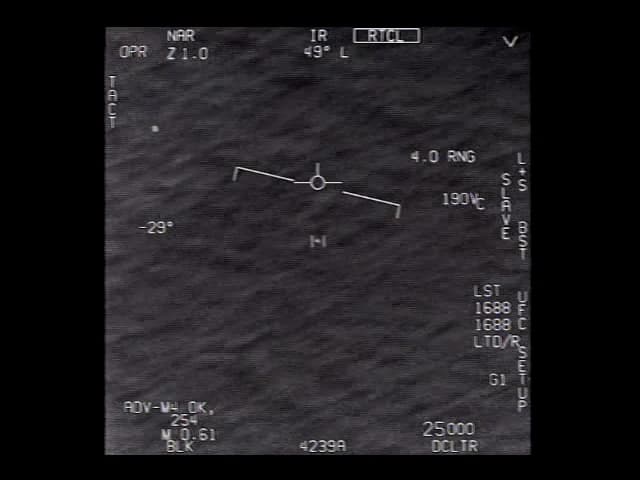
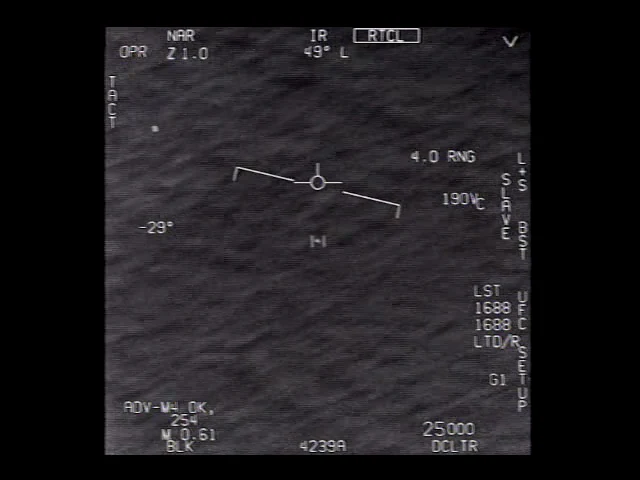
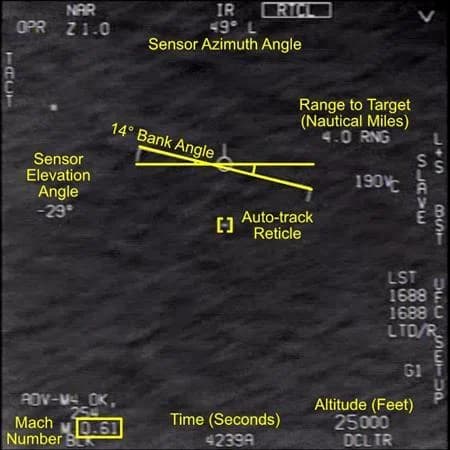
- 149° LPod azimuth: 49° left
- 2−29°Pod elevation: 29° down
- 34.0 RNGRange to object: 4.0 nautical miles
- 4|•|Tracked object
- 5M 0.61Aircraft speed: Mach 0.61
- 625000Aircraft altitude: 25,000 feet
- 74239ASensor clock
Frame t1 of AARO's analysis (clock 4239): these are the numbers the altitude is calculated from.
Frame · Video 19.1 s · Sensor clock 4239A · U.S. Navy / NAVAIR FOIA Reading Room · Public domain
Image record
- Author
- U.S. Navy
- Origin
- NAVAIR FOIA Reading Room
- Original file
- 3 - GOFAST.mp4 ↗
- License
- U.S. Government work: no U.S. copyright (17 U.S.C. § 105)
- Retrieved
- 2026-10-04
- Video SHA-256
- 02ec3458ad40d9db1d5385291c3fba53bfa7cf68113335a58e602967784cd559
The appearance of U.S. Department of War (DoW) visual information does not imply or constitute DoW endorsement.
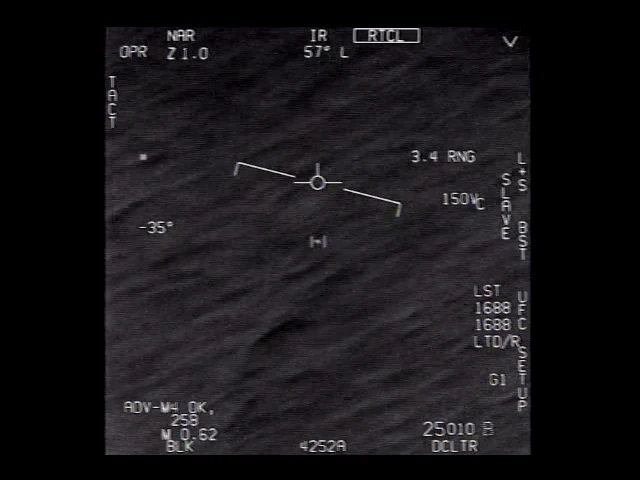
- 157° LPod azimuth: 57° left
- 2−35°Pod elevation: 35° down
- 33.4 RNGRange to object: 3.4 nautical miles
- 4|•|Tracked object
- 5M 0.62Aircraft speed: Mach 0.62
- 625010Aircraft altitude: 25,010 feet
- 74252ASensor clock
Frame t2 (clock 4252), 13 s later: the pod turns further left and down, and the range drops to 3.4 NM.
Frame · Video 32.6 s · Sensor clock 4252A · U.S. Navy / NAVAIR FOIA Reading Room · Public domain
Image record
- Author
- U.S. Navy
- Origin
- NAVAIR FOIA Reading Room
- Original file
- 3 - GOFAST.mp4 ↗
- License
- U.S. Government work: no U.S. copyright (17 U.S.C. § 105)
- Retrieved
- 2026-10-04
- Video SHA-256
- 02ec3458ad40d9db1d5385291c3fba53bfa7cf68113335a58e602967784cd559
The appearance of U.S. Department of War (DoW) visual information does not imply or constitute DoW endorsement.
02 Parallax lab
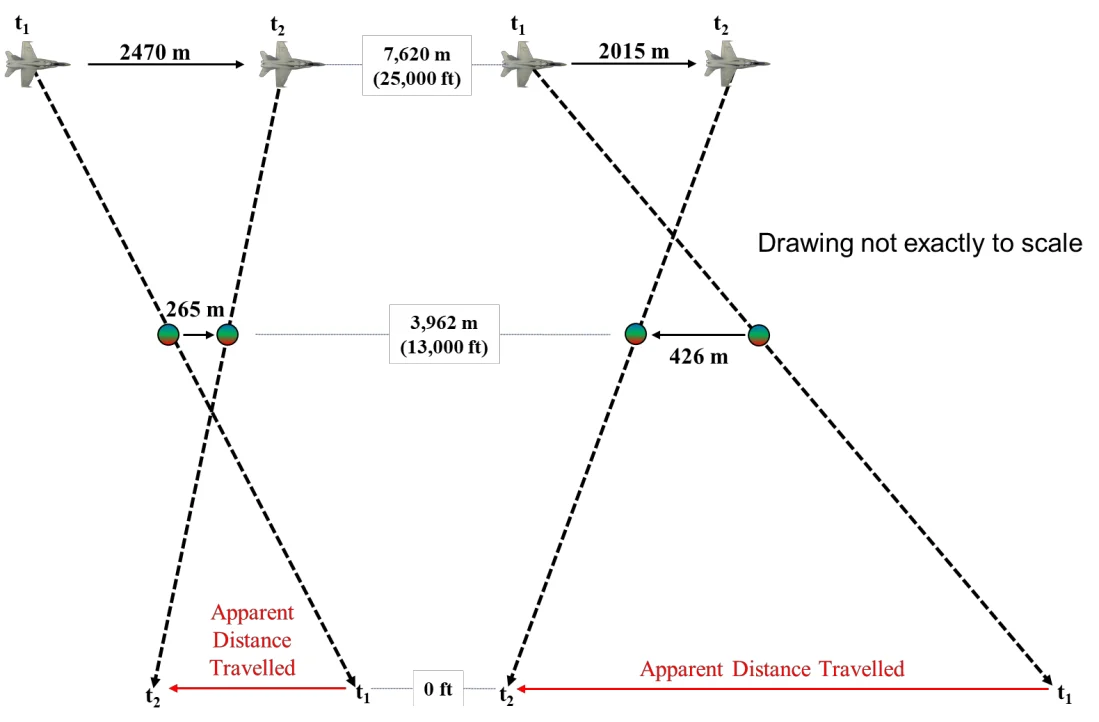
The display shows what the camera sees, not where the object is. A slow, high object seen from a fast jet seems to sweep across the ocean behind it at great speed.
- Appears to move over the sea at
- 379 mph · 610 km/h
- Actually moves at
- 46 mph · 73 km/h
Illustrative diagram: the jet flies at 25,000 feet at about 190 m/s and tracks the object, which moves 265 m in 13 s. Only the altitude changes.
03 Images from the file
Only images from the records themselves: official pages, charts and photos, and drawings the witnesses handed in. Artist's recreations and AI-generated images are not shown, even when the catalogue includes them.
04 Timeline
An F/A-18F records with its infrared pod an object that seems to skim the ocean at high speed. [1 · p. 1]
The video circulates after an unauthorized leak. [6][8 · p. 11]
The DoD authorizes its release; the Navy hosts it in its FOIA library. [6][7]
NASA analyzes the display's numbers: the object is at about 13,000 feet, moving at about 40 mph, a typical wind speed at that altitude. [2 · p. 28]
AARO presents its analysis to the Senate: about 13,000 feet and 45 mph. [3 · p. 5][4 · p. 15]
AARO publishes the resolution with every calculation: high confidence of no anomalous performance; the object is not identified. [1 · p. 1–26]
05 Hypotheses
Status as stated by the official sources cited. The archive takes no side.
- Ruled out
An object skimming the sea at high speed
What it looked like. The altitude derived from the display itself (elevation and range) is about 13,000 feet, not the surface. [1 · p. 1][2 · p. 28]
- Compatible
A slow object at about 13,000 feet; the speed is parallax
The apparent speed comes from the aircraft's motion and parallax against the ocean behind. [1 · p. 3–4][2 · p. 28]
- Compatible
Something drifting with the wind: a balloon, bird or small drone
AARO: one meter or less, “comparable to a small drone or bird”, and never against the wind. NASA: colder than the ocean, with no propulsion heat. No source identifies it. [1 · p. 1, 4][2 · p. 28]
06 Testimony
“the object is not actually close to the water but is rather closer to 13,000 feet.”07 Editor's reading
The editor's opinion, not an official finding. It rests on the records cited and changes if they do.
- Conventional explanation likely
- Open
- Anomalous
- At about 13,000 feet, the speed that impresses in the video is parallax: the object moves at about 40–45 mph, roughly with the wind. [1 · p. 1, 3–4][2 · p. 28]
- It measures one meter or less and never moves against the wind: it fits something drifting, like a balloon. [1 · p. 1, 4]
- It is colder than the ocean and shows no propulsion heat. [2 · p. 28]
- What keeps it open: no source identifies it. Unidentified does not mean anomalous. [1 · p. 1]
— Isaac Chaves, editor · Reading of
08 Discrepancies between sources
- AARO's Senate slides (2024) date the case to “January 2016” and say the DoD released the video in 2017. AARO's 2025 report and the DoD say January 2015; 2017 was the leak and the official release is from 2020. [3 · p. 5][1 · p. 1][6]
- NASA estimates about 40 mph over 22 s at about 15° of bank; AARO, about 45 mph over 13 s at about 14°. They are different stretches of the video and reach the same conclusion. [2 · p. 28][1 · p. 7, 13]
09 Sources
- [1]
Report · All-domain Anomaly Resolution Office (AARO) · Feb 6, 2025
Case: “Go Fast” · Case Resolution (with Appendix A: Estimating UAP Location, Speed, and Heading)
AARO calculates the object was at about 13,000 feet, moving at 5 to 92 mph with the wind removed. It concludes with high confidence there was no anomalous performance, though it cannot identify the object.
Checked on Oct 4, 2026 · Open the original ↗
- [2]
Report · NASA · Sep 14, 2023
Unidentified Anomalous Phenomena Independent Study Team Report
NASA's independent team sets out how to study UAP with calibrated data. As an example it analyzes GOFAST: about 13,000 feet and 40 mph, a typical wind speed at that altitude.
Checked on Oct 4, 2026 · Open the original ↗
- [3]
Record · All-domain Anomaly Resolution Office (AARO) · Nov 19, 2024
AARO case slides · Senate Armed Services Subcommittee on Emerging Threats and Capabilities
AARO's Senate slides on three resolved cases, including GOFAST: about 13,000 feet and 45 mph.
Checked on Oct 4, 2026 · Open the original ↗
- [4]
Hearing · U.S. Senate · Committee on Armed Services, Subcommittee on Emerging Threats and Capabilities · Nov 19, 2024
To Receive Testimony on the Activities of the All-domain Anomaly Resolution Office
Transcript of the hearing where AARO director Jon Kosloski presented the GOFAST analysis.
Checked on Oct 4, 2026 · Open the original ↗
- [5]
Record · All-domain Anomaly Resolution Office (AARO)
UAP Imagery
AARO's official imagery catalogue. It lists FLIR and GIMBAL as unresolved cases and GOFAST with its case resolution.
Checked on Oct 4, 2026 · Open the original ↗
- [8]
Report · All-domain Anomaly Resolution Office (AARO) · May 30, 2025
Fiscal Year 2025 Consolidated Annual Report on Unidentified Anomalous Phenomena
AARO receives 319 new reports and resolves 370 cases in the period; its holdings total 1,870 reports as of May 30, 2025.
Checked on Oct 4, 2026 · Open the original ↗
May contain errors by the AI and the editor · always check the official source. · Privacy